


Keeping Your Business Audit-Proof
Go to ArticleTax Tip: Two Special Stock Rules—Section 1202 and Section 1244

For owners, investors, and founders of small businesses, two federal tax rules can make a meaningful difference when stock is sold or becomes worthless: Section 1202 qualified small business stock and Section 1244 small business stock.
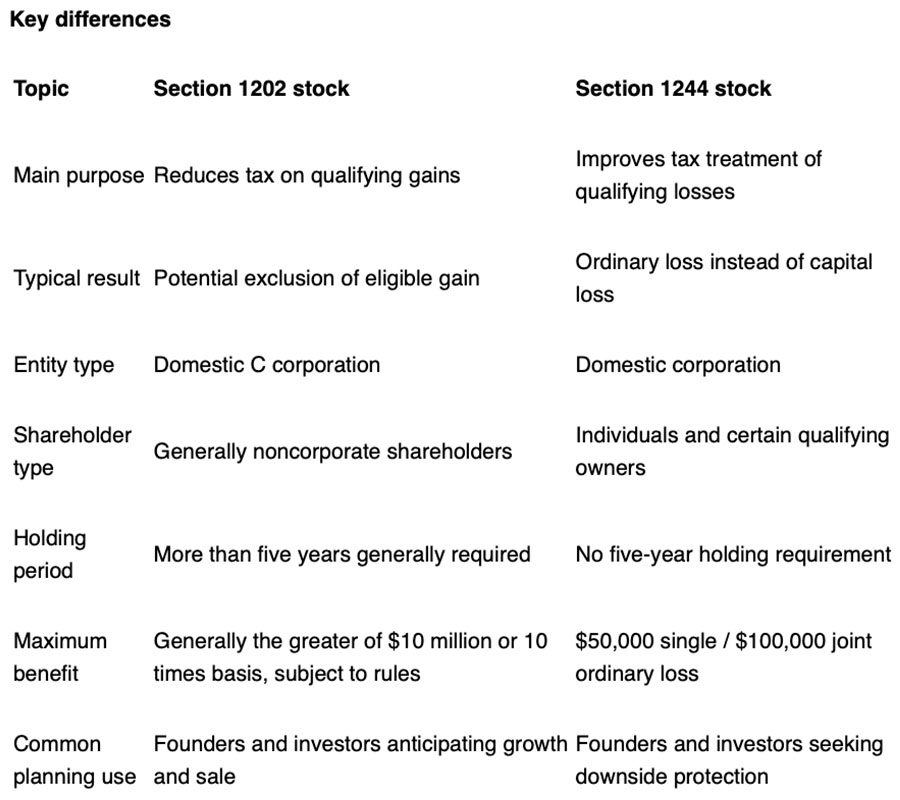
They serve different purposes:
Section 1202 can provide a substantial tax benefit when qualifying stock is sold at a gain.
Section 1244 can provide more favorable tax treatment when qualifying stock is sold at a loss.
These rules apply to stock in corporations—not partnership interests or LLC membership interests unless the LLC has elected to be taxed as a C corporation.
Section 1202: Potential exclusion of gain
Section 1202 applies to certain stock in a qualifying domestic C corporation, often called qualified small business stock (QSBS). If the requirements are met, an eligible noncorporate shareholder may be able to exclude some or all of the gain from the sale of the stock.
For stock acquired after September 27, 2010, the potential exclusion is generally 100% of eligible gain, subject to important limits. The exclusion is generally limited to the greater of:
$10 million, reduced by prior section 1202 gain exclusions from the same corporation; or
Ten times the shareholder’s adjusted basis in the qualifying stock.
The stock generally must be held for more than five years before it is sold. The corporation must generally be a domestic C corporation, and its gross assets generally cannot exceed $50 million immediately before or immediately after the stock issuance. The business must also satisfy active-business requirements; certain service, financial, hospitality, farming, natural-resource, and other excluded businesses may not qualify.
Simple example
Assume an investor purchases qualifying QSBS for $250,000 and sells it more than five years later for $4 million. If all the requirements are met and no special limitations apply, the investor may be able to exclude the $3.75 million gain from federal income tax.
The potential benefit is significant, but the requirements are technical. Eligibility depends on how and when the stock was issued, the corporation’s asset level and business activities, the shareholder’s holding period, and whether any redemptions or transfers affect qualification.
Section 1244: Better treatment for losses
Section 1244 is essentially the counterpart to Section 1202. It can help an individual investor or owner who experiences a loss on qualifying small-business stock.
Normally, a loss from stock is a capital loss. Capital losses can offset capital gains, but only a limited amount—generally $3,000 per year for individuals—can offset ordinary income. Any excess capital loss generally carries forward.
If the stock qualifies as Section 1244 stock, a loss may instead be treated as an ordinary loss. That means it can offset wages, business income, interest, retirement distributions, and other ordinary income without the usual capital-loss limitation.
The maximum ordinary-loss treatment is generally:
$50,000 for single filers.
$100,000 for married taxpayers filing jointly.
Any loss above those limits is generally treated as a capital loss.
Simple example
Suppose a taxpayer invests $80,000 in qualifying Section 1244 stock and later sells the stock for nothing. If the taxpayer is single and all requirements are met, up to $50,000 of the loss may be deductible as an ordinary loss. The remaining $30,000 is generally capital loss treatment.
This can be especially valuable for founders and early investors whose business does not succeed, because the ordinary portion of the loss can directly reduce other taxable income in the year of the loss.
Planning reminders
Stock must generally be acquired directly from the corporation for money, property other than stock, or services. Buying stock from another shareholder generally does not qualify for Section 1202.
The corporation must meet separate eligibility rules for each provision. A corporation may potentially issue stock that qualifies under both provisions, but the tax benefit depends on whether the shareholder ultimately has a gain or a loss.
Documentation matters. Maintain stock-purchase records, capitalization tables, corporate formation documents, evidence of the original issuance, financial statements, and records supporting the corporation’s business activities and gross-asset level.
State treatment can differ. Some states do not conform fully to the federal Section 1202 gain exclusion, so a federal exclusion may not eliminate state income tax.
Do not assume a startup investment qualifies simply because the company is small. Corporate status, stock issuance, business activity, asset limits, ownership changes, and redemption activity can all affect eligibility.
If you own stock in a growing C corporation, are considering a sale, or have stock that may be worthless, contact us before completing the transaction. Early review can help preserve potential Section 1202 gain exclusion or Section 1244 ordinary-loss treatment.